Turn the primary up the secondary and the arc gets longer. It is the first thing anybody tries and it is the wrong way round. Coupling does not buy length. It buys the ratio of the arc to the coil that threw it, and those are different things that happen to be measured in the same units.
Two coupled resonators have a coupling at which one response peak becomes two. With no arc out, every Tesla coil ever built sits far above it. Put an arc on and a QCW closes to about 4.5 times critical and an ordinary DRSSTC drops below 1, because which of the two circuits sets the threshold changes hands while the coil fires.
Critical coupling, the one absolute mark on the axis
Couple two tuned circuits and the single resonance splits. Below a certain coupling it does not: there is one peak, and the pair behaves like one circuit that rings a bit longer. Above it there are two peaks with a dip between them. The value where that changes is the critical coupling, and it is the only absolute mark on the coupling axis. Everything else on this site compares coils with each other.
The matched case is textbook. A Chinese national planned textbook, Higher Frequency Electronic Circuits under Zeng Xingwen, introduces a coupling factor A = kQ as its equation (2-28), calls A = 1 the critical coupling, and names the coupling coefficient there:
k_c = 1 / Q equation (2-33)It is a 424 page PDF rather than a page of text, so the equation numbers are how to find it. Read back a few lines from (2-28) and the assumption is stated outright: L1 = L2, C1 = C2, Q1 = Q2. A Tesla coil violates all three by orders of magnitude, so the question is not whether that form applies but what replaces it.
The unmatched case is worked in a 2018 paper on frequency splitting in wireless charging by Tang Guoshen and colleagues at Shandong University, whose stated contribution is exactly that gap: the literature before it assumed matched primary and secondary. Its equation (3) defines a generalised coupling factor lambda = wM / sqrt(r1 * R), and with M = k * sqrt(L1 * L2), Q1 = wL1/r1 and Q2 = wL2/R, the inductances and resistances cancel and it becomes
lambda = k * sqrt(Q1 * Q2) [derived from equation (3)]Where the threshold actually falls
The paper puts critical coupling at lambda = 1, in those words. Its own equation says otherwise. Equation (7) normalises the secondary current to
alpha = 2*lambda / sqrt( (1 - x1*x2 + lambda^2)^2 + (x1 + x2)^2 )where x1 = Q1*d and x2 = Q2*d are the two circuits' detunings on one common d. The response splits when resonance stops being the maximum, which is when that bracket starts falling as d leaves zero. Differentiating it there gives
splits when lambda^2 > (Q1/Q2 + Q2/Q1) / 2 [derived from equation (7)]and substituting lambda = k * sqrt(Q1 * Q2), the coupling that does it is
k_c = sqrt( (1/Q1^2 + 1/Q2^2) / 2 ) [derived]Set Q1 = Q2 and that is 1/Q, the textbook's own result, which is the check that this is the same statement made general rather than a different one. Set the two far apart and it is not 1/sqrt(Q1 * Q2). The two forms agree only where the circuits match, which is the case the paper set out to leave behind.
k_c is the root mean square of the two circuits' 1/Q, and a root mean square is set by its larger term. So the lossier of the two circuits fixes the threshold almost on its own and the better one barely enters. Everything below is that sentence with numbers in it.
What that threshold does in a coil
The coil this site works from runs k = 0.421, and the two quality factors it needs are not equally well known.
With no arc, the primary decides, and nobody publishes it unloaded
Q2 unloaded is 199. That is what JavaTC prints as "Secondary Q" for this winding, worked at the secondary is a resonator. It is a program's output for a coil somebody typed in, not an instrument reading, and this page says so rather than calling it a measurement. Q1 is published exactly once in everything we have read, and it is the wrong end of the axis for this table: dr. kilovolt lists "Ipk=100A (bus voltage dropping to approx. 650V) which translates to Qpri~11" among the measured data for his ferrite-cored SiC coil, which is a loaded figure inferred from a peak current, on a machine with a rod core through the primary. No unloaded one is published anywhere. The span used below runs from 5, when an arc is loading the primary, to 100 or more when it is not, and that span is the honest state of the knowledge.
no arc, Q2 = 199
Q1          k_c        k / k_c
  5       0.1415         3.0
 20       0.0355        11.8
100       0.0079          53          [derived, all three]
A factor of 18 across a column nobody has measured. At the top of a bang, "how far above critical is this coil" has no answer.
With an arc on it, the secondary decides, and this coil does publish that
An arc hangs across the topload as a parallel resistance and spends the secondary's Q. This site publishes 210 kΩ for it, which Uspring worked out of Hydron's measured topload currents on a 160 mm DRSSTC (HVF 117). Against this coil's characteristic impedance of 26.6 kΩ,
1/Q2 = 1/199 + 26.6/210 -> Q2 = 7.6and the table changes shape.
under an arc, Q2 = 7.6
Q1          k_c        k / k_c
  5       0.1693         2.5
 20       0.0995         4.2
100       0.0933         4.5          [derived, all three]
The column that moved the answer by 18 with no arc out moves it by 1.07 between Q1 = 20 and Q1 = 100 once there is one. With the primary's Q anywhere above the secondary's, the multiple reduces to sqrt(2) * k * Q2, which is 4.52 here [derived], and the primary has dropped out of the arithmetic entirely.
That is the finding, and it is the reverse of what the unloaded table suggests. The unknown changes hands while the coil fires. With no arc the primary is the lossier circuit, it sets the threshold, and the multiple cannot be stated. Once the arc is out the secondary is lossier by a wide margin, it sets the threshold instead, and the answer lands on 4.5 whatever the primary is doing. A coil is least knowable at the start of a bang and most knowable at the end, which is the reverse of the order these numbers usually get quoted in.
It is the same mechanism as the frequency slide on its own page, read on another axis. The arc loads the resonator; the resonator's frequency moves and its Q falls; one shows up as the tuning walking down the ramp and the other as the machine walking down this scale.
How fast it walks
Once Q2 is well below Q1 the multiple goes as Q2 itself, not as its square root, because the root mean square has stopped being a compromise between the two circuits and become the secondary alone. So the last part of the collapse costs twice what the geometric mean form would charge for it. Over a whole bang, at Q1 = 100, the walk is 53 down to 4.5, a factor of 12 [derived].
That multiple is not the distance to the poles merging
Worth separating, because the two get run together and they are conditions on different quantities. Udo Lenz, on the Tesla Coil Mailing List in February 2013, gives the Tesla case: system loading makes the centre frequency and one pole go away, leaving one frequency near the primary's resonance, and that happens when Qsec drops below 1/k. It is written on the secondary's Q alone. This coil's 1/k is 2.4, so at a loaded Q2 of 7.6 the margin is 3.2. There is no secondary frequency works the whole of it, including Lenz's own warning that a large split between the two uncoupled resonances brings the collapse on sooner than the condition alone predicts.
Put the two side by side and they are the same coordinate. With the primary's Q the higher of the two, the threshold derived above reduces to k * Q2 = 0.71, against Lenz's k * Q2 = 1 [derived]: a factor of 1.41 apart, one from a 2013 mailing list post about Tesla coils and one from a 2018 paper about charging cars, neither citing the other.
They also agree on the machine where it matters. An ordinary DRSSTC runs k = 0.12 to 0.2, the band Kaizer's design guide gives, and Uspring puts the loaded Q of Hydron's coil at about 4. At k = 0.15 with Q2 = 4:
Q1          k / k_c
  5          0.66
 20          0.83
100          0.85          [derived, all three]
Below critical coupling for every primary Q in the band. Lenz's margin on the same two numbers is 0.6, also below. Two conditions, two literatures, one verdict: an ordinary DRSSTC under a full arc has no pole pair left to choose from. A QCW's 0.30 to 0.50, which is where the wall puts the two air-cored builds that publish a coupling at all, Anders Mikkelsen's 0.497 and paulsimik's 0.40, with this coil's 0.421 between them, is what keeps one alive. That is the point the two-pole page makes from the other side, and it is a better reason to couple a QCW tightly than the arc-to-secondary ratio it is usually given for.
What raising k does to the tank
The secondary is not a separate machine. Its losses appear across the primary as a resistance, and the size of that resistance is set by the coupling:
R_ref = w^2 · k^2 · L_p · L_s / R_sThe square is the whole argument. Double the coupling and the secondary looks four times as lossy from where the bridge is standing. The bridge is a voltage source into a series circuit, so the current it can push through that circuit is what falls:
I_pk = (4/pi) · V_bus / R_totalRaise k and R_total goes up, I_pk comes down, and the power going into the arc comes down with it. Nothing about that is subtle and nothing about it is controversial. Uspring puts it as the primary looking lossy: the transfer of power to the secondary is itself what takes the primary current down.
What the record holders actually run
If coupling bought length, the longest arcs would be the most tightly coupled ones. They are the opposite.
- BrOdin measures his ground strikes with a tape: 14 feet from breakout point to ladder, and later a 15 foot ground strike, which is 427 to 457 cm [derived, 30.48 cm to the foot], off a 12.75 by 48 inch secondary, so 324 mm in diameter [derived]. The 17 foot mark stays a mark: the ladder is at 17 feet, and he says he did not get an arc to it that time. His coupling is JavaTC's throughout and it moves: 0.18 on the secondary that flashed over at long ontime, then 0.185 with the first turn of the next one at the bottom edge of the primary, then 0.164 to 0.146 by raising the secondary an inch to stop racing sparks, and 0.141 on the secondary after that. The longest arcs on this list, and the table further down says that is not loose coupling: his class starts at 0.154 for 315 mm and 0.165 for 400 mm, so 324 mm starts at about 0.155 [derived, between those two rows]. His 0.146 is about six per cent under his own starting figure and his 0.185 about a fifth over it [derived]. He is coupled normally for his coil, and the coil is a large one.
- Anders Mikkelsen gets 318 cm off a 16.4 cm secondary at
k= 0.497. That is 19.4 times the coil, and about seven tenths of BrOdin's longest [derived]. - ZakW gets 122 cm off a 5.0 cm secondary: 24.4 times the coil, and just over a quarter of BrOdin's length [derived].
- Daniel Eindhoven's RAIKIRI staff gets 350 cm off a 14 cm secondary, at 25 times the coil the highest ratio here, on a 900 V bus into a full bridge of silicon carbide.
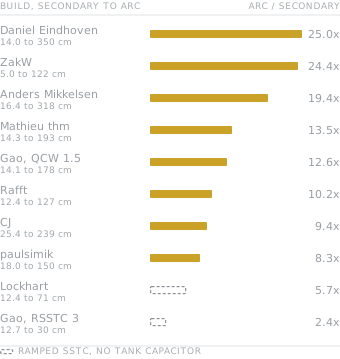
The metres sit at the bottom of the coupling range. The ratios sit at the top. The two highest ratios on the wall come off fourteen and five centimetre secondaries, throwing three and a half metres and a metre respectively; BrOdin's coil throws more than either from the bottom of the band. Which of his couplings was on the coil for the 15 foot strike is not established here: the strike and the figures are in different posts, and the coil was rewound between several of them.
Before any of those numbers are used
Of the eight published coupling figures behind this page, not one is stated by its author as a measurement of k. That is not a complaint about sloppiness. Coupling is not a thing a meter reads: it comes out of geometry, or out of inductances, or out of a pair of frequencies, and which route was taken changes the answer.
By how much is on the record, on one coil, at one tap. loneoceans publishes both his figure and the frequencies behind it, and his word for the figure is calculated, from the geometry of the system:
0.306   his own, from geometry          his word: calculated
0.323   from his poles, secondary ungrounded   282 / 394 kHz   [derived]
0.337   from his poles, secondary grounded     255 / 362 kHz   [derived]
Ten per cent between the first and the last, and nothing changed but the route. His final configuration is the 0.38 quoted everywhere, and that number is an inversion out of frequencies he measured, which makes it a measurement of frequencies rather than of coupling.
The clearest case is the one where somebody asked. dr. kilovolt lists k = 0.55 under "Measured data", and davekni asks him directly, "Did you ever measure coupling factor?" The whole of the reply is that the coupling coefficient is 0.55, as written in the first post. The value again, not the method. A heading that says measured does not make a measurement of everything under it.
An ordinary DRSSTC lives at 0.12 to 0.2, the band Kaizer's design guide gives. A QCW lives at 0.30 to 0.50, which is the same trade taken deliberately: a QCW is trying to make a long arc off a short coil, so it pays current for ratio on purpose.
Two published figures sit above that band and neither belongs in it. A k of 0.55 and one of 0.71 are both reached with ferrite in the primary's magnetic path: a rod core in dr. kilovolt's, and a ferrite floor and centre post in davekni's oversized QCW, the top of the post NiZn. Every coil in the band above is air cored, and putting a partial magnetic circuit on the same ladder compares two different machines. They are worth knowing and they are a separate line, not the top of this one.
But that band is mostly not a range of choices. It is a range of coil sizes. The same guide carries a starting table, credited to a rule of thumb from Bart Anderson: begin at 0.117 for a one inch secondary, and let the figure rise with the diameter. The millimetres below are the table's own column, not our reading of its size classes:
class         secondary dia.   starting k
Micro              40 mm         0.120
                   50 mm         0.125
Mini               75 mm         0.128
Medium            110 mm         0.130
                  160 mm         0.135
Large             200 mm         0.140
                  250 mm         0.146
Very large        315 mm         0.154
                  400 mm         0.165
Ten times the diameter buys 0.045 of coupling, and that alone spans most of the ordinary band before anybody has made a decision. So loose and tight are not absolute here. A number is loose or tight for a coil of that size, and the guide is explicit that even this is only a first try: it says there is no fixed answer and encourages experiment.
Which is enough to size the QCW departure properly, and it is not one number. The wall mostly publishes winding lengths rather than diameters, so where it does not this site's own aspect band for these coils, 1.28:1 to 1.67:1, turns one into the other: ZakW's 5.0 cm of winding is 30 to 39 mm of diameter, and the small end of the span is his 30 mm. The large end is not derived at all, because CJ's note gives the coil outright as six by ten inches, so 152 mm. The nine builds therefore run from about 30 mm to 152 mm, which is 1.2 to 6.0 inches [derived]. Read Bart's table across that span and the size-appropriate baseline is 0.118 to 0.134, so a QCW's 0.30 to 0.50 is about 2.2 to 4.2 times what a coil of its own size would have started at, with the middle near 3.1.
It has to stay a band, for two reasons that are worth separating. One end of the span is derived through an aspect ratio that is itself a range, so the multiplier inherits that width. And the machines are not one size: five times separates the smallest secondary here from the largest, so "QCW coils are small, and small coils belong at the bottom of the band" is true of half this list and false of the other half. The size correction does not lift the multiplier, it stretches it, because the class of machine is itself stretched.
Where all of this sits on an absolute scale
Everything above compares coils with each other. There is a scale that does not, and the whole page has been quietly standing on it.
Two coupled resonators have a critical coupling, the value at which the single response peak splits into two. Below it there is one peak; above it there are two, with a dip between them. A Chinese national planned textbook, Higher Frequency Electronic Circuits under Zeng Xingwen, gives it for the matched case as k_c = 1/Q in its equation (2-33), from the coupling factor A = kQ at A = 1. A 2018 paper on frequency splitting in wireless charging does the unmatched case, which is the one a Tesla coil is, and states its contribution as exactly that gap: the prior work assumed matched primary and secondary. Its equation (3) gives a generalised coupling factor, and substituting M = k·√(L₁L₂) turns it into λ = k·√(Q₁Q₂). The paper then puts critical coupling at λ = 1, which would make it 1/√(Q₁Q₂), a geometric mean. Its own equation (7) does not agree: differentiating that at zero detuning gives a root mean square instead.
k_c = sqrt( (1/Q1^2 + 1/Q2^2) / 2 )The derivation above shows it reducing to the textbook's 1/Q when the two circuits match, which is the check that it is the same statement made general. The difference is not cosmetic. A root mean square is set by its larger term, so the lossier of the two circuits fixes the threshold almost alone, while the geometric mean lets a healthy primary cover for a spent secondary.
Put numbers in it. This page's own unloaded secondary Q is 199, and a primary's runs from a handful when the arc is loading it to a hundred or more when it is not:
  Q1     Q2        k_c
   5     199      0.142
  20     199      0.036
 100     199      0.008
 100     100      0.010     [derived, all four]
Most of this page is far above it, and the exception is the interesting part. Against the three rows with a primary Q of 20 or more, an ordinary DRSSTC at 0.12 to 0.2 runs 3 to 25 times critical coupling and a QCW at 0.30 to 0.50 runs 8 to 63 [derived]. Against the top row, where an arc is already spending the primary, the same two bands land at 0.85 to 1.4 and 2.1 to 3.5: the ordinary machine is then sitting on the boundary rather than far above it, and that is the loaded case arriving early, out of the one row where the primary is already spending. The width of all those multiples is the width of Q, not of k. Read the table backwards and it says so: the four rows span a primary Q from five to a hundred, and the corpus has one builder's published figure to put in that column, dr. kilovolt's Qpri~11 on his own coil. So the vagueness in these multiples is not vagueness about coupling. It is the opposite, and worth saying plainly: on these machines the coupling is the better known of the two.
Which reframes the poles. They are not a complication that shows up when you couple too hard. They are what the whole field builds in before the arc is out, and a coil with a single response peak would be one nobody would want: critical coupling is where the energy transfer stops being fast. The two-pole page works out which of them a driver lands on, and this is why it never gets to skip that question.
And that multiple is not one number, which is a page of its own. With no arc it spans a wide range, because Q₁ is barely published at all. Under an arc it very nearly stops caring about Q₁ at all and lands near 4.5 for a QCW and below 1 for an ordinary DRSSTC, because Q₂ collapses while the coil fires and which of the two circuits sets the threshold changes hands. That is worked through above: the unloaded figure is the first microseconds of a bang and the loaded one is its end, and they are a sequence rather than a range.
The wall on the other side
There is a reason nobody simply winds the primary tighter and accepts the lost current. Racing sparks have been caught inside the band above rather than above it, and on the coil with the longest arcs on this page. The secondary BrOdin wound at 0.185, and quotes a week later at 0.164, gave him massive racing sparks with the current limit at 2000 A, long before any large streamers even formed, and the cure was less coupling: raising the secondary an inch, which JavaTC put at 0.164 down to 0.146, was enough to run at 2000 A without them. So this page used to say that the same coefficient does both and therefore the coefficient is not what decides. It is one coil, and lowering k fixed it, so that reading is withdrawn. What the record supports is narrower and more useful: the ceiling belongs to the winding, not to the number. There is a machine built around exactly that limit rather than against it, and it buys its coupling with a third coil instead of a tighter winding: a DRSSTC magnifier is not just a longer coil. davekni had to take his own coil from 0.157 to 0.14 with more resin layers to stop secondary arcing, and says he would love 0.18 but his 160 mm secondary diameter limits getting there, while BrOdin's 324 mm one carried 0.164 to 0.185 before it flashed. The turn to turn voltage up the secondary is not distributed the way the coupling coefficient suggests, and the coil flashes over its own winding before any of the arithmetic above has a chance to matter.
And this is where the QCW's 0.30 to 0.50 stops looking like recklessness. Racing sparks are a secondary voltage failure: the winding flashes over along itself before the energy has finished moving. A ramp slow enough for an arc to form removes that voltage, because the arc clamps it. Anders Mikkelsen puts both halves in one sentence on his thread about poles and detuning: ramp slowly enough that an arc has time to form, in order to clamp the secondary voltage to a low value, which allows long sparks from a short resonator without the risk of flashover, and also allows high coupling to be used.
So a QCW does not break the coupling rule. It removes the reason the rule exists, and then spends what that frees. Which is why the escape is not available to you on a banged coil: there, the voltage arrives before any arc does, and the wall is where it always was.
So what does buy length
Energy, and slowly. Across the measurements that exist the arc goes as the cube root of the energy in the bang:
L ~ E^n, n = 0.31 to 0.33A cube root is a hard master. Eight times the energy for twice the arc, and the eight has to come from somewhere: a higher bus, a longer ontime, more capacitance in the tank, and each of those has its own wall. That is why millimetres per kilowatt does not work as a figure of merit. It assumes a straight line through a curve, and it is not even defined until you say how long the bang lasted.
Four ways the multiple gets misused
k_cis treated as a property of the coil. It is a property of the coil and its load, and the load is the arc, which changes through every bang. The same geometry and the same unchangedksit at 53 times critical before the arc forms and at 4.5 by the time it is out.- An unloaded multiple is quoted about a loaded coil. The large figures belong to the first microseconds of a bang, before there is an arc. Quoting one of those about a machine mid ramp overstates it by about 12 at
Q1= 100. - A large multiple is read as room to spare. It is not the distance to anything happening. Whether there are still two poles is Lenz's question and it is answered on the secondary's
Qalone, which is why an ordinary DRSSTC can sit at 0.83 times critical under a full arc while its coupling never moved. - The two forms of
k_care treated as interchangeable.1/sqrt(Q1 * Q2)is a geometric mean and the form above is a root mean square. On this coil under an arc, atQ1= 100, they differ by a factor of 2.6: 11.6 against 4.5. The geometric mean flatters the machine, because it lets a healthy primary cover for a spent secondary, and nothing in the physics allows that.
At the bench
- Set the coupling from the geometry you can survive, not from a length you want. Start looser than you think and creep up.
- Measure the primary current before and after every change to
k. If it fell and the arc did not, the coupling was not the limit. - When the arc stops growing, look at the bus and the ontime before you look at the coil. The cube root means the coil is rarely the cheapest thing to change.
- Treat the first racing spark as the ceiling for that winding, permanently.
The figures above are collected from published builds rather than measured here, and the ratios are arithmetic on the builders' own numbers. Four of them have been read at the source: RAIKIRI, a QCW 1.5 and ramped SSTC, and BrOdin's, whose thread is linked post by post above. RAIKIRI's page has since stopped serving any of it, so that one was read and cannot be checked again at that address. The rest came off a compilation of forum threads, and the records page keeps them apart from the ones that did not.