Run straight off the mains in continuous mode, the coil draws just under 5 A. With a steel screwdriver as the breakout point, that is over a kilowatt into a very small volume of air. The tip goes white hot, sparks keep flying for seconds after the power is off, and the shop's lifetime guarantee is void. Then the singing arc. The mains is rectified and smoothed to 340 V DC, the driver is biased to half its maximum pulse width, and an audio signal from a CD player varies the MOSFET conduction time around that point. He calls it low-level modulation in the driver, as against the bulky and inefficient way of varying the supply. He gets about 75 W of RF with no audio, 80 percent depth, 200 W peak envelope and a bushy plume about 5 in long. The page also explains why an arc sings. More power heats it and it expands, less and it contracts, and the movement makes the sound. By his own change log it went on his site on 7 Oct 2001. It is the earliest SSTC music we have found, and an early case of modulating on the driver side rather than the bus. The list agreed in 2004. Dan McCauley's history names Burnett the first to audio-modulate a solid-state coil, and Terry Fritz agreed with it.
Schematics and photos
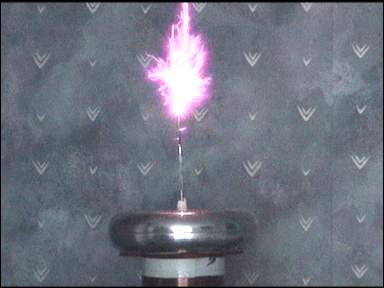
photo: the screwdriver tip burning in the plume 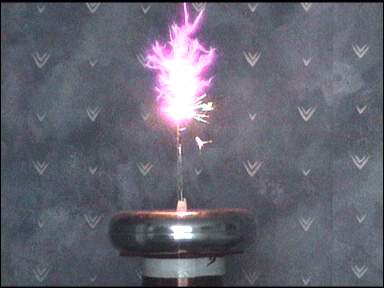
photo: the plume, continuous mode 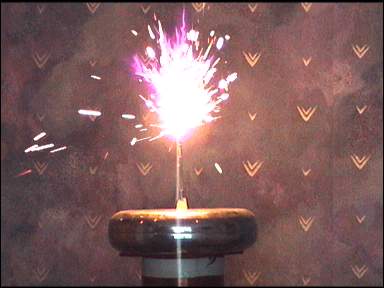
photo: steel sparks off the white-hot tip 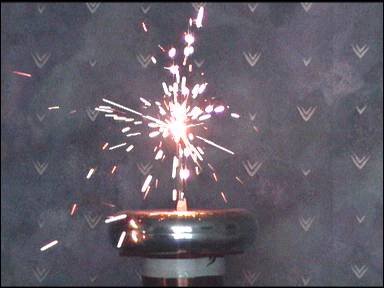
photo: sparks after switch-off 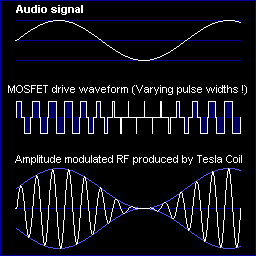
diagram: audio in, pulse width out, amplitude-modulated RF
Sources
- richieburnett.co.uk: Singing arcs and burning steel
- Internet Archive: richieburnett.co.uk, what's new (19 Oct 2001, his dated change log)
- pupman.com: Dan McCauley, Needed: SSTC History and Achievements (8 Jun 2004)
- pupman.com: Terry Fritz, the reply (10 Jun 2004)
This is the card from the driver tree, written from what the builder published. Send corrections through the forum.