What changed because of them
There were solid-state experiments back to the 1980s, but by Anders Mikkelsen's account Burnett is the first person to build a solid-state coil that performed and to document it properly, on a page of his own with schematics, outside any forum. The page carries no year, but his change log does: the solid-state coil went up on 9 May 2000, the 18 in pictures on 9 December 2000 and the singing arc on 7 October 2001. The Internet Archive first captured the page itself on 6 October 2001.
The first coil: a 1000-turn resonator 7 in tall by 3 in across under a 6 by 2 in toroid, a 25-turn primary around its foot driven straight from the bridge, no tank capacitor, two IRF740s in a half bridge straight off the 240 V mains and a TL494 free-running at about 250 kHz, no feedback. Then he ran it from four different supplies and photographed what the sparks did: half-wave rectified mains gave 10 ms bursts and straight, unbranched sword sparks of about 6 in; full-wave made them fatter and bushier but no longer; smoothed DC made a hissing jet; a phase-angle controller with a sharp rise made them branched and spidery. That is the envelope effect, the thing every ramped coil on the tree is built on, documented about a decade before the first QCW; the effect itself, Mikkelsen adds, was already known from voltage-doubled VTTCs.
The second coil, the 18 in sparks page: four STW15NB50s in an H bridge, half-wave mains with no storage capacitor, 1200 W in and 4800 W peak envelope, a 3.5 by 16 in resonator at 350 kHz, and the drive frequency swept with the mains cycle to follow the resonator as the spark grew, which he calls very crude and which is feedforward tracking by any other name. Without it, he writes, growing sparks snub themselves out by detuning the coil. A photograph on the page is from Cambridge 2001.
His singing arc page is the earliest SSTC music this site has found: 340 V DC, the MOSFET conduction time varied by the audio, low-level modulation in the driver rather than the supply, 80 percent depth, a 5 in plume, and an explanation of why an arc sings at all: more power and it heats and expands, less and it contracts. His 4 MHz coil, a 500 W continuous-wave class-E design on a page archived in May 2004, is what later sent Steve Ward to Class-E, and Steve Conner's site thanks him by name. He has not been asked yet; the photographs here are from his pages, each credited and linked, and come down the day he asks.
Their boards
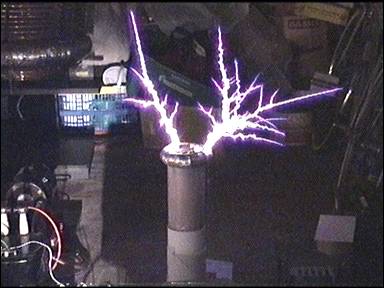
the H-bridge coil at work 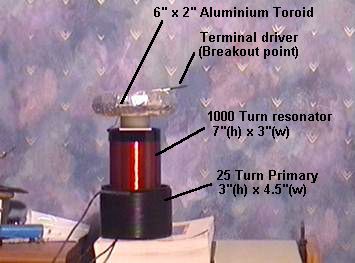
the first coil, annotated by its builder 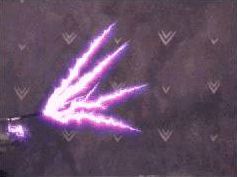
half-wave rectified mains: the straight sword sparks 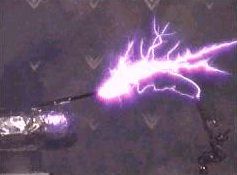
full-wave rectified: fatter and branched, no longer 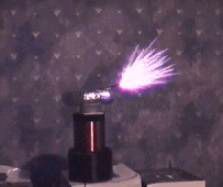
smoothed DC: the hissing cone 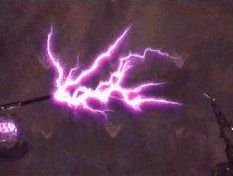
phase-angle control: spidery and dancing 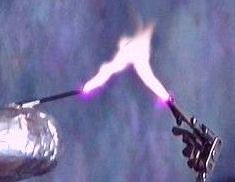
a ground strike arching upward in its own heat 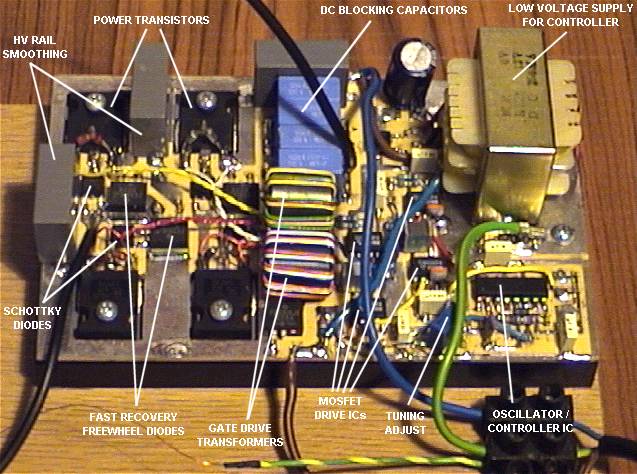
the H-bridge driver board, annotated by its builder 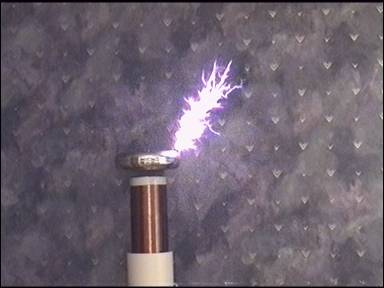
the 9 in flame on smoothed DC 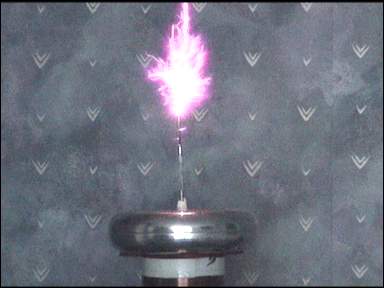
a steel screwdriver as the breakout point, continuous mode 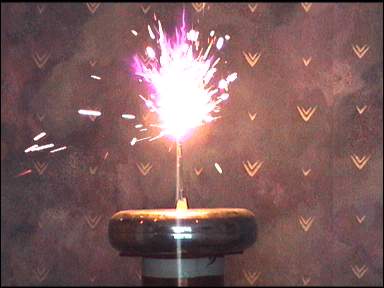
steel sparks off the white-hot tip 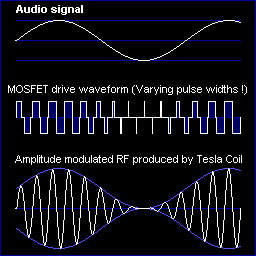
audio in, pulse width out, amplitude-modulated RF
Builds and boards on the tree
- Half-bridge SSTC, the four supply modes · May 2000
- H-bridge SSTC, 18 in · October to December 2000
- Singing arc and burning steel · October 2001
- The mains-ramped coil, root of the QCW tree · May 2000
Sources
- richieburnett.co.uk: Solid state tesla coil
- richieburnett.co.uk: Singing arcs and burning steel
- Internet Archive: the page as first captured, 6 Oct 2001
Written from what Richie Burnett published, by one person, so it can be wrong in places. When Richie has an account here, the page becomes theirs to edit: the paragraphs, the place and the links above, in their own words. Corrections from anyone else go to the forum, and anything Richie Burnett asks to change or remove is changed the same day.