She names the failure this fixes. The oneTesla v1 kit driver has no dead time between its gate pulses, so the two IGBTs overlap and die early. Her add-on inserts an adjustable gap. The title block is signed Donna Whisnant / Dewtronics, “oneTesla PWM Dead-Time Driver”, Rev 1.0, 14 December 2016, KiCad. The handle `dewhisna` on GitHub is hers.
The sheet is split in two, and each half says whose circuit it is. The upper half is labelled “Original oneTesla Circuit”. It has a CST206-3A current transformer at 1T:300T, a 1 kΩ 5 W burden, a 74HCT14 chain, a 74HC74, and UCC37322 and UCC37321 onto the gate-drive transformer through 6.8 Ω to each IGBT. Two crosses marked “Cut Here” show exactly where to break it, and a note on the ‘21 reads “Replace with UCC37322 !!”. The lower half is hers: a 74LS123 dual one-shot forming the sync pulse into an SG3525. Its three trimmers are labelled on the sheet: Sync Pulse Width (20 k), Free-Running Frequency (2 k) and Dead-Time (100 Ω). OutA and OutB are wired back to “UCC37322 #1 Pin 2” and “#2 Pin 2”.
The setting-up procedure is printed on the drawing. Turn the dead-time pot until the wanted gap appears between OutA and OutB. Set the free-running frequency about 5 % below the primary’s resonance. Then widen the sync pulse until the SG3525 locks to the current-sense signal. A table gives the 74LS123 timings: 220 pF/330 Ω = 50 ns, 220 pF/470 Ω = 74 ns, 470 pF/330 Ω = 108 ns, with a warning that its inputs need at least 40 ns.
The repository also has the earlier working notes. A pencil sheet dated 31 May 2015, headed “oneTesla Musical Tesla Coil · SG3525 Driver”, carries the numbers she was aiming at (“@286 kHz maxDead = 794 ns, minDead = 266 ns”) and the later marginal note “both are now 27322 non-inv!”. The repository states no licence, and no photograph of a built board is published. The two sheets are all there is.
Schematics and photos
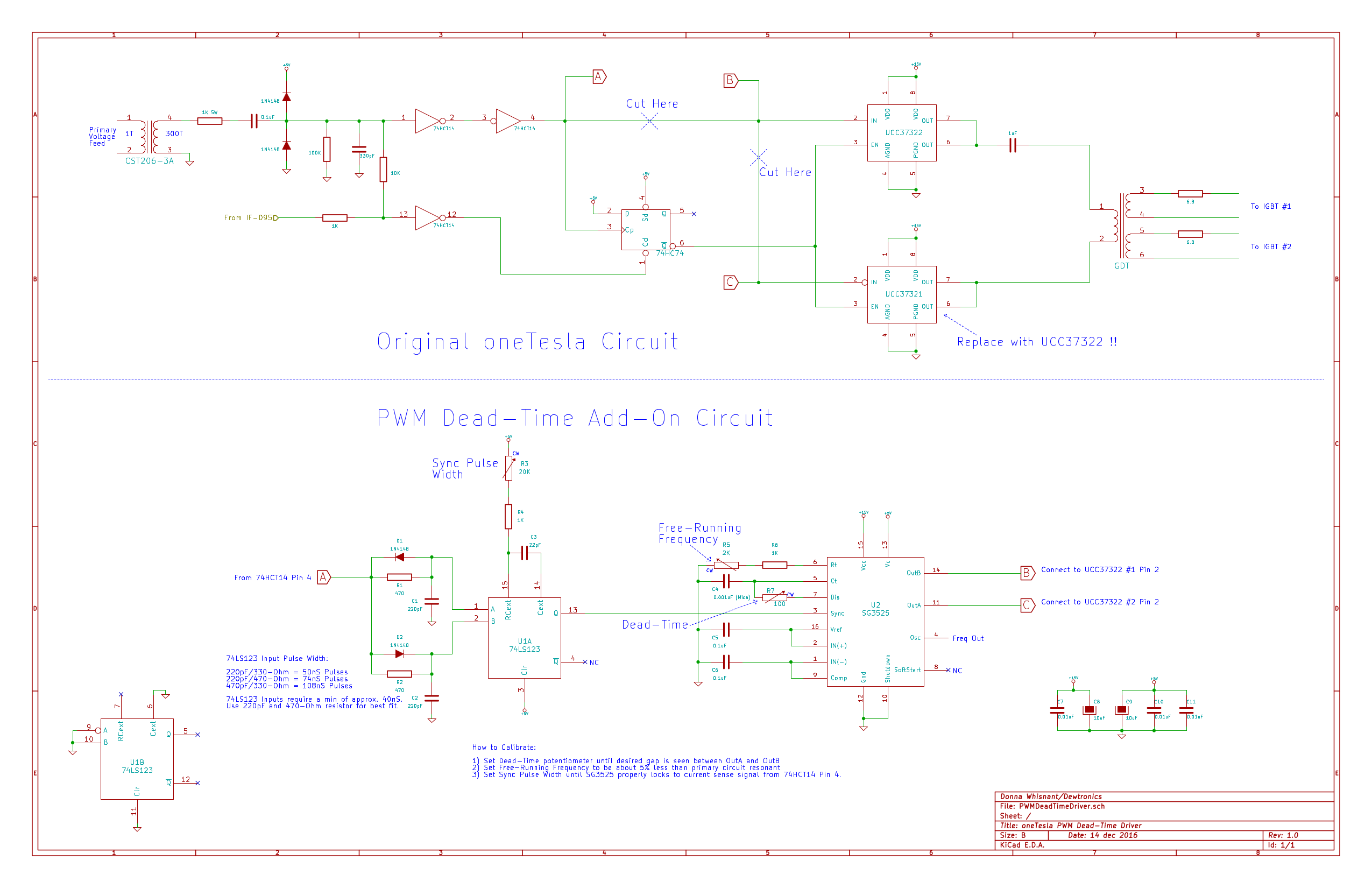
schematic: “oneTesla PWM Dead-Time Driver”, Rev 1.0, 14 Dec 2016, signed Donna Whisnant/Dewtronics 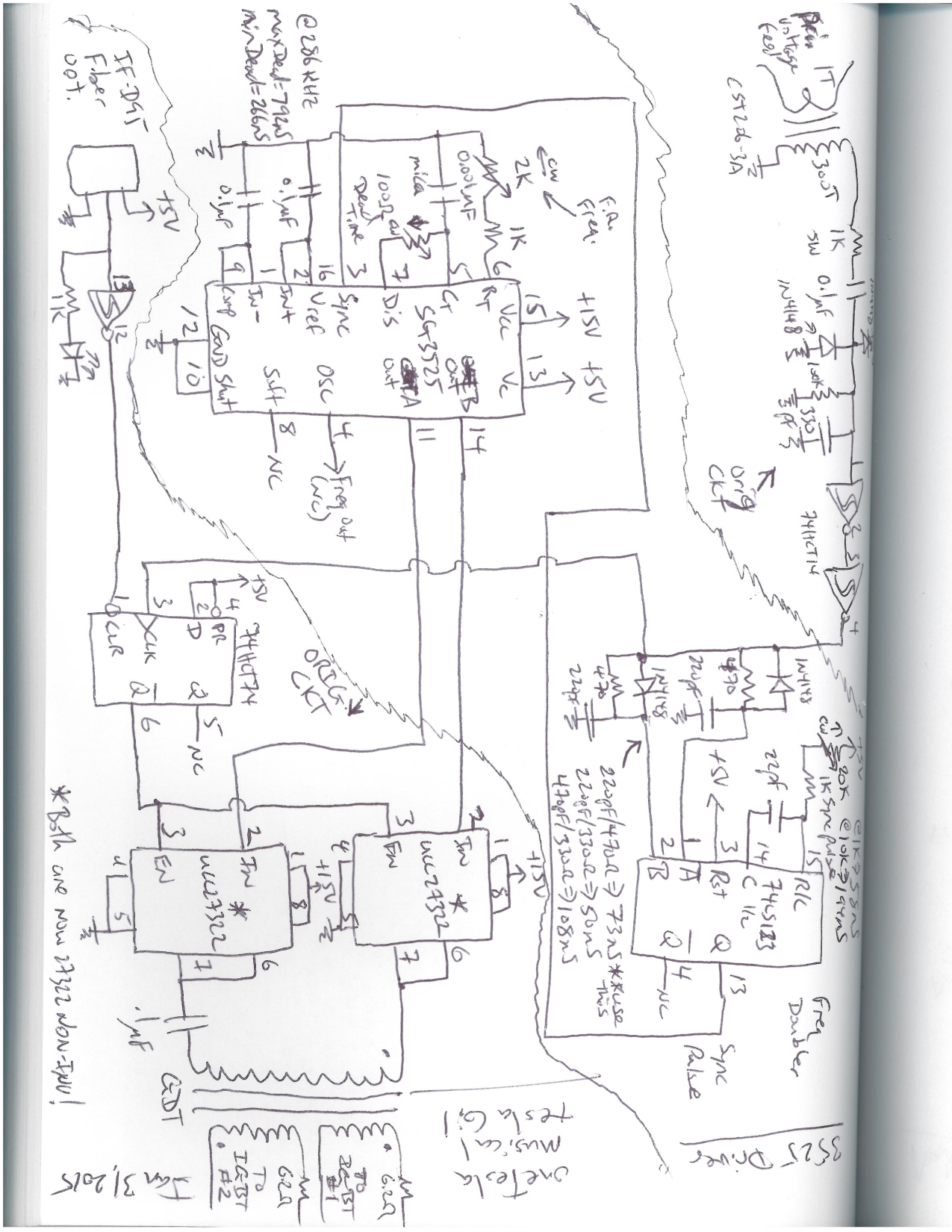
her working notes, 31 May 2015: dead-time targets at 286 kHz, in pencil
Sources
This is the card from the driver tree, written from what the builder published. Send corrections through the forum.